

Disc Tube Reverse Osmosis (DTRO) uses a disc-tube membrane configuration with relatively open hydraulic passages. Compared with conventional spiral-wound RO, its hydraulic design can offer practical benefits in certain fouling-prone wastewater applications.
A containerized DTRO system integrates selected equipment into a factory-assembled enclosure, typically including membrane modules, high-pressure pumps, pipework, instruments, PLC controls and cleaning provisions. Pretreatment, feed tanks and concentrate handling may be separate packages.
Typical applications include landfill leachate, selected industrial wastewater, RO concentrate reduction and temporary or modular treatment projects. Suitability must be verified from actual wastewater analysis.
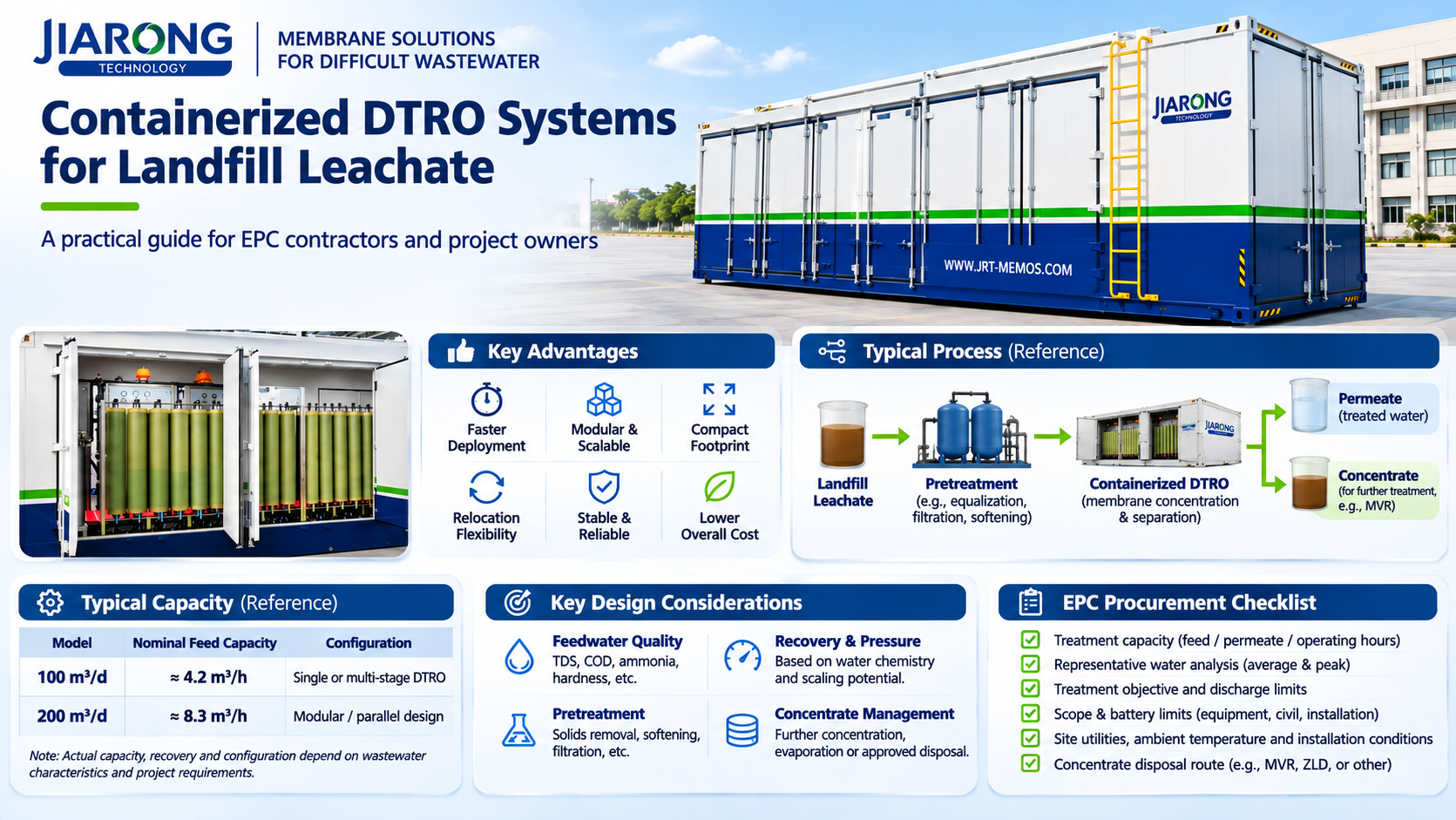
Reduced site assembly. Factory integration can lower the amount of mechanical and electrical work performed at the project site. Site preparation, external piping, power connections and commissioning are still required.
Modular expansion. Capacity can be expanded through parallel units where site conditions, hydraulics and operating strategy allow. For example, two nominal 100 m³/day feed modules could be evaluated for a 200 m³/day feed requirement; actual duty and redundancy must be confirmed.
Compact equipment layout. Major equipment is concentrated within an enclosure, but space remains necessary for access, pretreatment, chemical storage and concentrate management.
Potential relocation. A packaged unit may suit temporary projects, subject to transport limits, permits, utilities and verification of the new feedwater.
The main advantage is predictable integration—not the elimination of engineering work.
A specification such as “100 m³/day DTRO” is ambiguous. Does it mean feed capacity or treated-water output?
Membrane recovery (%) = Permeate flow ÷ Membrane feed flow × 100
For an illustrative requirement of 100 m³/day membrane permeate at an assumed 60% recovery:
Required membrane feed: approximately 167 m³/day
Membrane concentrate: approximately 67 m³/day
At 20 operating hours/day: feed 8.3 m³/h; permeate 5.0 m³/h
These calculations exclude pretreatment, cleaning and downtime losses. The 60% recovery figure is hypothetical, not a performance guarantee.
Also distinguish membrane permeate from net usable product water, which may be lower after plant-wide losses. EPC tenders should state each quantity explicitly.
Request representative average and worst-case results: flow, pH, conductivity/TDS, COD, ammonia, suspended solids, oil and grease, temperature, hardness, calcium, magnesium, sulfate, silica and alkalinity. TDS alone cannot predict scaling or achievable recovery.
Equalization, solids separation, flotation, filtration, chemical conditioning or softening may be required. DTRO can tolerate some challenging hydraulic conditions, but its open-channel design does not prevent inorganic scaling or remove the need for pretreatment.
Higher recovery reduces concentrate volume but raises brine salinity and osmotic pressure. The nominal pressure rating of a DTRO module is not proof of a particular achievable recovery. Membrane selection must consider salt composition, flux, temperature, scaling and pressure limits.
Confirm power supply, foundation loading, feed storage, ventilation, access, drainage, chemical safety and connection points. In hot climates, evaluate actual membrane feed temperature and any need for cooling or insulation.
DTRO produces permeate and a concentrated reject stream; salts are not destroyed. Confirm whether concentrate will be further treated, evaporated, returned to an approved process or disposed of through a permitted route. DTRO alone is not Zero Liquid Discharge (ZLD).
| RFQ Item | Minimum Information |
|---|---|
| Capacity | Feed, permeate and operating hours |
| Feedwater | Full analysis and seasonal variability |
| Performance | Product quality and discharge limits |
| Recovery | Target plus feasibility assumptions |
| Pretreatment | Existing units and scope boundaries |
| Utilities | Power, water, drainage and temperature |
| Concentrate | Volume, chemistry and final destination |
| Delivery scope | Container, external tanks, civil works, installation |
| Acceptance | FAT, SAT, commissioning, training and spares |
Specify the battery limits: which items are inside the container, which are supplied separately, and who is responsible for external piping, civil works, permits and concentrate disposal. This prevents an attractive equipment quotation from hiding major project costs.
Compare technically feasible proposals on a consistent basis:
Equipment CAPEX and site installation
Pretreatment and chemical consumption
Energy use and membrane maintenance
Downtime, cleaning and replacement parts
Concentrate treatment and disposal costs
Commissioning, operator training and local support
A compact unit with a high claimed recovery rate is not necessarily the lowest-cost solution if it requires extensive upstream treatment or creates difficult downstream brine.
Can containerized DTRO treat raw landfill leachate?
Sometimes, but pretreatment depends on solids, oil, scaling potential and other feed characteristics. Direct feed suitability must be demonstrated.
Is a 100 m³/day system rated by feed or permeate?
Either convention may be used. Always request both figures, the operating-hour basis and the guaranteed performance conditions.
Can containerized DTRO achieve 75% recovery?
Not universally. Recovery is limited by salinity, ionic composition, pressure, scaling and pretreatment. It requires case-specific assessment.
Is it suitable for hot climates?
Potentially, with feed-temperature and container-environment controls designed for the actual site.
Does a DTRO container achieve ZLD?
No. A downstream concentrate and residue management process is still required.
Jiarong Technology supplies DTRO-based modular treatment systems for landfill leachate and difficult wastewater applications. Depending on project requirements, the treatment configuration may combine pretreatment, containerized membrane concentration and interfaces with downstream evaporation or other concentrate treatment.
Our goal is to match system configuration to verified feedwater, treatment objectives, operating conditions and lifecycle costs—not to promise a universal recovery rate.
Planning a containerized DTRO project? Send your water analysis, required flow, permeate targets, site location and concentrate-disposal requirements to Jiarong for a preliminary technical assessment.
Share your water quality data and discharge requirements, we'll help assess a feasible and stable treatment approach
Submit